01
What harmonic mixing is & why it works
Every piece of music is in a key — a home set of notes that the melody and bass belong to. When you play two tracks at once, as you do in every blend, their notes either agree or fight. If the keys are compatible, the overlapping melodies and basslines sound consonant — full, emotional, intentional. If the keys clash, you get a subtle (or not so subtle) sourness, a tension that makes listeners feel something is wrong even if they can't name it.
Harmonic mixing simply means choosing your next track so its key is compatible with the one playing. Done well, long blends become lush and musical, and you can layer a vocal from one track over the instrumental of another without it sounding painful. It's one of the biggest upgrades you can make to how your sets feel.
The good news: you don't need to know any music theory. DJ software analyses the key of every track for you, and a simple tool called the Camelot wheel turns key compatibility into easy numbers. The next lessons show you how to read it and use it.
02
Keys, notation & the Camelot wheel
Musically, keys have names like 'A minor' or 'C major', and there are 24 of them — which is a lot to juggle in a dark booth. The Camelot wheel (also called the Camelot system or 'key codes') solves this by relabelling every key as a number from 1 to 12 plus a letter, A or B. So A minor becomes 8A, and C major becomes 8B. Most DJ software (rekordbox, Serato, Engine, VirtualDJ) can display this Camelot code right next to each track.
Picture a clock face numbered 1 to 12. Each number has two keys: the 'A' (minor, generally darker or more emotional) and the 'B' (major, generally brighter or happier). That's the whole system — a position on the clock, and an A or B.
You don't need to memorise which song is in which key. You just read the code your software shows — say 8A — and use the simple rules in the next lesson to find a compatible track. Turning keys into a clock of numbers is what makes harmonic mixing practical to do live, on the fly, without a music degree.
03
The rules: which keys mix together
Here are the only rules you need, all based on moving around that 1–12 clock. From whatever key you're playing, three moves are reliably compatible.
First, stay on the same code: 8A mixes perfectly with another 8A. Same key, guaranteed smooth — the safest blend there is. Second, move one step around the clock, keeping the same letter: from 8A you can go to 7A or 9A. These neighbours share most of their notes, so the blend stays consonant while the mood shifts slightly. Third, switch the letter at the same number: 8A to 8B. This jumps between the minor and major version of the same root — the notes are compatible but the feeling brightens or darkens, a lovely way to lift or deepen the energy.
That's it: same number, one step around (same letter), or flip the letter. Do those and your blends will sound harmonically right. As you get comfortable you'll learn a few bolder moves (like jumping by a couple of steps for an energy boost), but these three will carry you a very long way and never sound wrong.
04
Mixing for energy with key changes
Harmonic mixing isn't only about avoiding clashes — it's a tool for controlling energy and emotion across your set. Each compatible move has a feel, and once you know them you can steer the room on purpose.
Staying on the same code keeps the mood steady — great for a long, hypnotic stretch. Moving up one step around the wheel (8A to 9A) gives a subtle lift, a sense of rising energy; moving down a step settles things. Flipping from a minor to the major of the same number (8A to 8B) brightens the mood noticeably — perfect for the moment you want to take the room from moody to euphoric — while major to minor adds depth and tension. There's also a well-known 'energy boost' move of jumping two steps up the same letter (8A to 10A), which lifts the key by a whole tone for a real surge — use it when you want the crowd to feel a gear change.
Think of your set as an emotional journey and the wheel as your steering: small steps to glide, a letter flip to change the colour, a bigger jump to inject energy. Selecting tracks with both the right energy and a compatible key is what makes a set feel composed rather than random.
05
Key Sync, Key Shift & practice
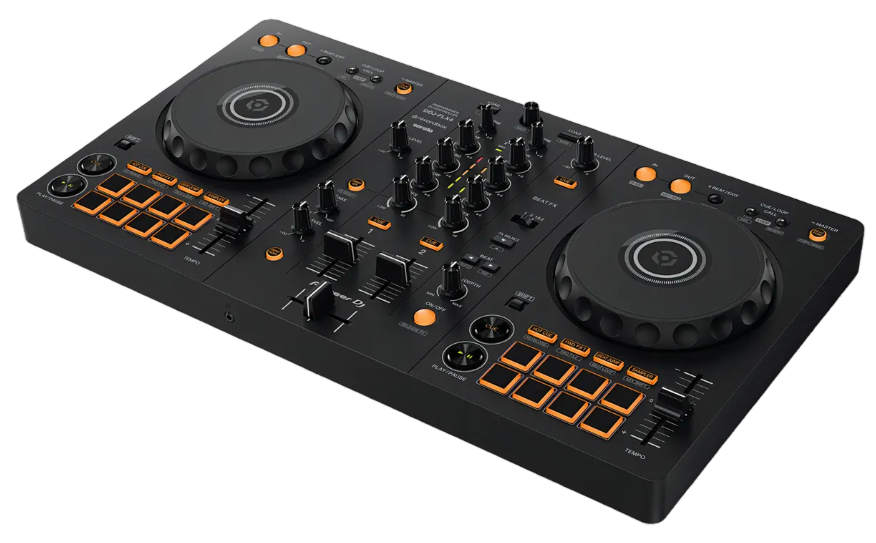
Modern gear can help you mix in key. Key Sync (on CDJs, many controllers and standalone units) shifts the current track into the same key as the other deck at the press of a button, so two tracks that were a little incompatible become consonant. Key Shift (or Key Adjust) lets you nudge a track's key up or down by hand — handy for forcing a blend to work, or for a creative pitch effect. The feature that makes this possible without changing the speed is sometimes a separate tool, like Serato's Pitch 'n Time, which lets you change key without changing tempo and vice versa.
A word of caution: shifting a key too far starts to sound artificial, so small moves are best — use Key Sync and Shift to smooth a near-miss, not to force wildly different tracks together.
To build the habit, start simple: turn on the key display in your software, and when you pick your next track, just check that its Camelot code follows one of the three rules from lesson 3. Do that for a few sets and it becomes automatic. Better still, organise your library by key so compatible tracks are easy to find mid-set. Mix in key consistently and people will tell you your sets sound 'professional' without knowing exactly why — this is the secret behind that feeling.