01
Why levels matter: gain staging
Gain staging is just making sure every track plays at a similar, healthy volume through your mixer. It sounds boring, but it's one of the biggest things separating amateur and professional sound. Get it wrong and two problems appear: tracks jump in volume when you switch (one song is quiet, the next blares), and pushing levels too hot makes the sound distort and lose punch.
Music is mastered at different volumes, so a track from 2005 might be quieter than a modern one. If you don't correct for that, your mix is a rollercoaster of loud and soft — exhausting for a crowd and a giveaway that you're new. The fix is to set each incoming track's gain so it matches the level of the one already playing, every single time.
Think of your signal as water flowing through pipes: you want a strong, steady flow that fills the pipe without overflowing. Too little and it's weak; too much and it spills (distorts). The next lesson shows you exactly how to set that flow using the meters on your mixer — the simple habit that instantly makes your sets sound even and powerful.
02
Set the trim with the meters
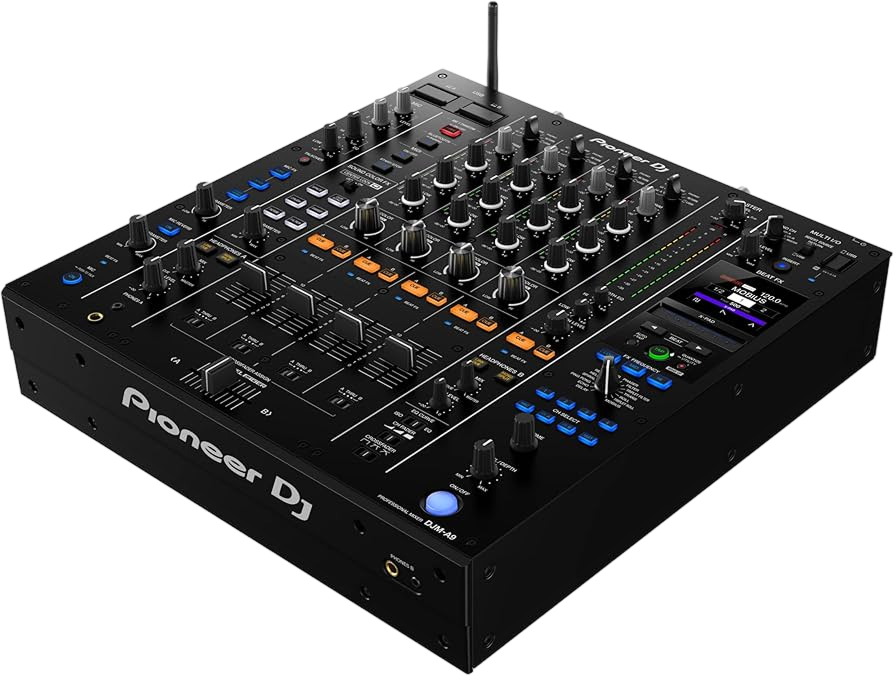
Every mixer has a trim (or gain) knob at the top of each channel and a row of meter lights for that channel. The meters show how loud the signal is: a stack of green lights, an amber zone near the top, and red at the very top. Red means too loud — the sound is clipping and distorting.
Here's the routine. When you load a track, before you bring it into the mix, listen to it in your headphones and turn its trim so the meter peaks up into the amber zone on the loudest part (the drop or chorus) but never hits the red. Do this for every track and they'll all be at a matching, healthy level — no jumps when you switch, no distortion.
A quick way to match by ear: with the current track playing, briefly preview the next one at the same fader position and adjust its trim until they sound equally loud. Keep an eye on your master meters too — the overall output should sit strong but out of the red. Clean gain staging is invisible to the crowd, but they feel it: the music stays loud, punchy and even all night, which is exactly what a great DJ delivers.
03
The 3-band EQ explained
Each channel has three EQ knobs: LOW, MID and HIGH. They let you turn up or down a slice of the frequency range for that track. LOW controls the bass — the kick drum and basslines, the energy you feel in your chest. MID controls the middle — most vocals, snares, guitars and synths, the 'body' of the music. HIGH controls the treble — hi-hats, cymbals and the 'air' and sparkle on top.
On a DJ mixer the EQ does two jobs. Turned up from the middle, it boosts that band, but DJs mostly use the EQ to cut — turning a band down, often all the way off ('full kill'), to remove part of a track. That's the key insight: EQ isn't just for tone-shaping, it's for carving out space so two tracks can share the speakers without fighting.
For example, cutting the LOW on a track removes its bass entirely so it can layer over another track's bass cleanly. Cutting the MIDS makes room for a vocal from the other deck. Cutting the HIGHS pulls a track back so it sits behind the one in front. Once you stop thinking 'tone control' and start thinking 'which part of this track do I want, and which do I want to make room for', the EQ becomes your most powerful mixing tool.
04
The bass swap
If you learn one EQ move, learn this. Two tracks each have a kick drum and a bassline, and the low end of music is mono and powerful — so when two basslines play together they don't blend, they clash into a muddy, undefined rumble that robs your mix of punch. The bass swap solves it completely, and it's the backbone of clean mixing.
Here's how. You're playing track A. You've beatmatched track B and it's ready. Before you bring B in, turn its LOW EQ all the way down — kill its bass. Now raise B's channel fader (or move the crossfader toward it): you hear B's highs and mids ride on top of A with no clash, because only A's bass is sounding. Let them play together for a few bars so the blend settles. Then, at a musical moment, make the swap: in one smooth move, turn A's LOW down to kill and turn B's LOW back up to full. The bass hands over from A to B instantly and cleanly — one bassline at all times, never two. Finally, fade A out.
That's the bass swap. Practise it slowly until the swap feels like a single gesture. It's the move that makes blends sound seamless and loud, and it works on every mixer ever made.
05
Creative EQ & common mistakes
Beyond clean blends, EQ is an expressive tool. Killing the bass on the whole mix for a few beats and slamming it back in on the downbeat creates a powerful 'drop' moment. Slowly cutting the highs and mids out of a track while it plays makes it feel like it's disappearing into the distance — a smooth way to retire a song. Riding the LOW up and down in time with the music adds groove. Used musically, EQ moves build and release energy just like effects do.
Now the mistakes to avoid. First, boosting too much: cranking the bass on every track stacks up and overloads your mixer into distortion — cut more than you boost. Second, forgetting to reset: if you killed an EQ band for a blend, turn it back to centre afterwards, or your next mix starts with a track missing its bass. Third, EQ-ing instead of gain staging: EQ shapes tone, but it's not a volume control — set your levels with the trim first, then use EQ for blending. Fourth, doing too much: a constant flurry of EQ twiddling sounds nervous. The pros make a few deliberate, well-timed moves — a clean bass swap, one tasteful filter-like cut — and let the music breathe. Clean levels plus purposeful EQ is the foundation every other skill sits on.