01
The flagship analogue mixer
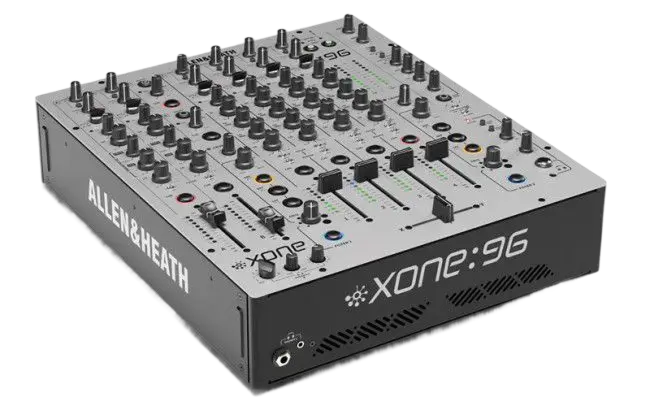
The Xone:96 is Allen & Heath's statement mixer — the gear you find in serious techno and house booths and in the studios of DJs who treat sound quality as non-negotiable. It's a six-channel analogue mixer (four phono/line channels plus two stereo channels) built with audiophile-grade components, so the signal stays clean, warm and detailed from input to master.
Unlike a digital all-in-one, the Xone:96 is a hub: you bring your own sources — turntables, CDJs, synths, drum machines, a laptop via its soundcards — and the mixer blends them all with analogue purity. That flexibility is why it's favoured by DJs who play hybrid sets mixing records, digital files and live hardware.
It's an advanced instrument with a lot of surface area, and this guide works through its architecture in stages. The reward for learning it is one of the best-sounding, most flexible mixing platforms made — a mixer many DJs consider an endgame purchase.
02
Dual soundcards & DVS
A defining feature of the Xone:96 is its two completely independent 96kHz/32-bit soundcards, each with its own USB connection. This means two laptops can be connected at once — ideal for back-to-back sets where each DJ runs their own software and library with no re-patching, and seamless handovers.
The soundcards also make the Xone:96 a superb DVS hub: connect timecode turntables or CD players and control Serato or another DVS package with the warm analogue sound of the mixer in the audio path. You get the feel and sound of analogue with the convenience of digital libraries.
Set this up deliberately — assign channels to the soundcard sends and returns, confirm each laptop sees its own interface, and check your gain staging so the digital and analogue sources all sit at matched, healthy levels (our Gain Staging & EQ Mixing guide covers this). Once configured, the dual-soundcard design makes the Xone:96 uniquely flexible for collaborative and hybrid performances.
03
External FX send/return loops
The Xone:96 has two independent send/return FX loops, letting you patch external effects units — hardware reverbs, delays, or effects pedals — directly into your mix. This is a hallmark of the high-end analogue approach: rather than relying on built-in digital effects, you choose outboard gear with the exact character you want and route it through the mixer.
In practice you send a channel (or the master) out to an effects unit, process it, and bring it back, mixing the wet signal in to taste. You can hold a delay on the tail of a phrase, wash a transition in reverb, or run a track through a characterful filter pedal — all with analogue signal flow.
This flexibility is a big reason techno and house DJs love the Xone:96: their effects sound is part of their identity, and the loops let them build it from chosen hardware. Our Filters & FX guide covers using effects musically; the principle of restraint matters even more with powerful outboard gear, where one well-placed effect defines a moment.
04
The four VCF filters
The Xone:96 carries the line's legendary VCF filters — and gives you four of them, arranged so they can be assigned across channels. These are the same resonant analogue low-pass/high-pass filters that made the Xone name, with that musical, almost vocal resonance as you sweep.
Having multiple filters opens up performances a single-filter mixer can't: filter two tracks independently as you blend them, build tension on one channel while opening another, or sculpt a layered, multi-source mix in real time. For techno and house, where filtering is a core expressive gesture, this is enormously powerful.
As always, the music leads. Time your sweeps to the phrasing — open a filter to lift into a drop, close one to dissolve a track into a bed (our Phrasing & Song Structure guide marks where these land). With four filters under your hands the temptation is to overuse them; the DJs who sound best use them precisely, letting each sweep mean something. Mastering the filters is mastering the soul of the Xone sound.
05
Running a hybrid setup
The Xone:96's real purpose is to be the clean, flexible centre of an ambitious setup. A typical advanced rig might run two turntables on DVS, a CDJ or two, and a synth or drum machine — all into the six channels, with the dual soundcards carrying digital decks and the send/return loops adding outboard effects. The mixer ties it together with analogue purity.
Managing that complexity is the final skill. Keep your gain staging disciplined across every source so nothing clips and everything sits at a matched level; know your channel assignments and filter routing cold so you're never hunting mid-set; and use the four-band EQ to carve space when multiple sources play at once. Our Gain Staging & EQ Mixing and How to Build a DJ Set guides both feed into running a rig this size.
The Xone:96 rewards this investment with a setup that few can match — pristine sound, total flexibility, and expressive control over records, files and live hardware alike. It's why so many top house and techno DJs treat it as the last mixer they'll ever need.