Home/Mixer/Allen & Heath Xone:23
Analogue 2-Channel MixerAllen & Heath Xone:23 Analogue 2-Channel Mixer
Allen & Heath · Intermediate

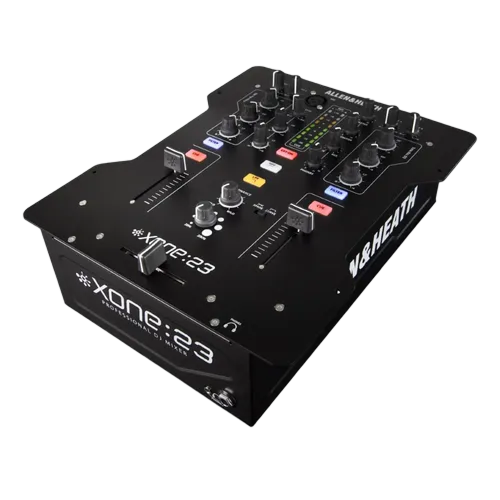
Allen & Heath Xone:23

A warm analogue club mixer with Allen & Heath's legendary VCF filter. Learn to mix house and techno with hands-on filter sweeps and pristine sound.

4
Lessons
Mixer
Type
Intermediate
Level
Overview

Everything the manual says — minus the headache.

The Allen & Heath Xone:23 is a compact analogue DJ mixer beloved in house and techno circles for two things: its warm, musical analogue sound, and the famous Xone VCF filter — a resonant low-pass/high-pass filter that's an instrument in its own right. With four stereo inputs across two channels and no menus to navigate, it rewards hands-on, ears-first mixing. This guide teaches you to use it, with special focus on the filter that defines the Xone sound.

  • Understand what an analogue mixer gives you
  • Wire up sources and set clean gain by ear
  • Mix two tracks with EQ and the crossfader
  • Perform with the resonant VCF filter musically
Advertisement
Lessons
01

Why analogue, why the Xone

The Allen & Heath Xone:23 belongs to a different tradition than the all-in-one digital controller. It's a purely analogue mixer: signal flows through real circuitry, not software, which gives it the warm, slightly characterful sound that house and techno DJs prize. There's no screen, no software dependency, and no menus — just knobs and faders that do one thing each. It has two channels, each able to take stereo line or phono sources (four stereo inputs total), so you can run turntables, CD players, or the outputs of other gear. You pair it with your own sources and, optionally, an external sound card or the Xone:23C variant for DVS. The Xone philosophy is hands-on and ears-first: you mix by listening and feeling, not by reading waveforms. That makes it a brilliant teacher of real mixing fundamentals, and a favourite of DJs who want their hands on warm-sounding circuitry. The crown jewel — the filter — is what we build toward in this guide.
02

Wiring up & gain by ear

Connect your sources to the channels — turntables to the phono inputs (which have the correct preamp), or line-level gear like CDJs and controllers to the line inputs. Plug the master output into your speakers or the club system, and your headphones into the front for cueing. With no screen, you set gain by ear and by the metering the mixer provides. Bring each channel's trim up until the track sounds full and the level meters sit healthy without pinning into the red. This analogue gain staging is a core skill: too low and your set is weak, too hot and you get distortion. Our Gain Staging & EQ Mixing guide explains the principles, which apply directly here. Learning to judge levels by ear, rather than watching a software meter, is one of the most valuable habits the Xone teaches. It makes you a better DJ on any gear, because you're listening to the actual sound rather than trusting a screen.

03

Mixing with EQ & the crossfader

Mixing on the Xone:23 is pure fundamentals. Cue the incoming track in your headphones, beatmatch it by ear (our How to Beatmatch guide covers the technique — there's no sync here, which is part of the appeal), and bring it in with the channel fader or crossfader. The three-band EQ is your main blending tool. The classic move is the bass swap: as you bring the new track in, pull its bass down, then trade — drop the outgoing track's bass as you raise the incoming one's — so two kick drums never clash. Our Gain Staging & EQ Mixing guide breaks this down. The Xone's EQ sounds musical and is satisfying to ride. Because there's no software safety net, every transition is on you and your ears — which is exactly why DJs who learn on a mixer like this develop such solid timing and EQ instincts. Get comfortable here, because the next lesson adds the Xone's secret weapon on top of these foundations.

04

The VCF filter as an instrument

The Xone:23's voltage-controlled filter (VCF) is what gives the mixer its cult status. It's a resonant analogue filter with both low-pass and high-pass modes and a resonance control that adds a vocal, whistling emphasis as you sweep — far more musical and aggressive than the gentle filters built into most digital mixers. Used well, it's a performance instrument. Sweep the low-pass up to gradually open a track into a drop; pull it down to dissolve the outgoing track into a muffled bed under the incoming one; crank the resonance for a screaming filter build that's a staple of techno. Because it's analogue, it sounds rich and reacts instantly to your hand. The key, as ever, is taste and timing — a filter sweep should follow the phrasing of the music (our Phrasing & Song Structure and Filters & FX guides explain where these moves land). One well-timed sweep into a breakdown does more than constant fiddling. Master this filter and you've got the heart of the Xone sound, and a genuinely expressive tool for house and techno.

Techniques to practise
Related gear
Advertisement