01
A DJ-producer instrument
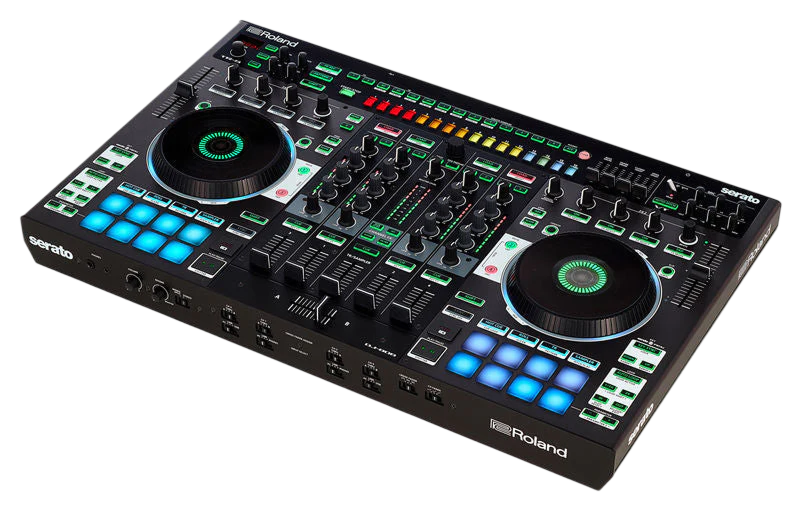
The DJ-808 was a landmark: the first time a major synth company (Roland) and a DJ software company (Serato) built hardware together. The result is a flagship controller that thinks like a studio. You get everything you'd expect — two large jog wheels, a four-deck Serato DJ Pro layout, 16 performance pads, balanced XLR outputs and a proper mixer section — plus three things rivals don't have: a real TR drum machine, a vocal transformer, and deep integration with Roland's AIRA instruments.
That changes what a 'set' can be. Instead of only blending finished records, you can layer live-programmed 808 and 909 drums, pump a pad with sidechain compression for that classic dance-floor breathe, and transform a vocal in real time. It's aimed at DJs who also produce, and at performers who want their sets to sound unmistakably theirs.
The rest of this guide builds you up from solid DJing to using these production tools live and tastefully.
02
Setup & the pro mixer section
The DJ-808 ships with a full Serato DJ Pro licence — no upgrade needed. Connect over USB, and use the balanced XLR master outputs to a club PA or your monitors; there's also a booth output and a mic input with its own EQ and effects. This is gear built to be plugged into a real venue.
Spend time on gain staging here because the unit gives you proper control: set channel trims so each track hits a healthy level without clipping, keep the master in the green, and use the booth output to set your own monitor volume independently. Our Gain Staging & EQ Mixing guide explains why this discipline keeps your set clean and loud without distortion.
The mixer section has full three-band EQ with kill, filter, and Serato's software FX on hand. Treat the DJ-808 as a hybrid: the audio path is hardware-grade, the brains are Serato. Getting levels right at the start makes everything that follows — drums, vocals, FX — sit properly in the mix.
03
Four-deck mixing & pads
With four Serato decks under your hands, the DJ-808 lets you go beyond A-to-B transitions into layered performance: a beat on one deck, an acapella on another, a loop rolling underneath. The 16 RGB pads cover Hot Cue, Loop, Beat Jump, Sampler, Slicer and more, so you can rearrange a track on the fly rather than just play it.
Build this gradually. Master clean two-deck blends and phrasing first (our How to Build a DJ Set guide is the backbone here), then add a third element — a vocal or a percussion loop — using hot cues to drop it exactly on a phrase boundary. The Slicer and Beat Jump pads are powerful for live edits and re-flips.
Because the jogs are large and high-quality, the DJ-808 also handles scratching well, so the pads plus jogs make it a strong creative-performance controller. Our Looping & Hot Cues and Scratching for Beginners guides pair directly with this lesson.
04
The TR-S drum machine & pump
This is the DJ-808's heart. The TR-S section is a genuine step sequencer with the classic Roland voices, and it locks to Serato's tempo so your programmed drums stay in time with the track. You build patterns step by step on the pads, choose which voice each step plays, and tweak the sound of each drum.
The standout feature is the pump (sidechain) control: you can make a track or a layer duck in volume each time the kick hits, producing the rhythmic 'breathing' that's everywhere in house and EDM. Used subtly it adds groove and glue; pushed hard it becomes an effect in its own right.
The musical discipline matters more than the buttons. Add drums to lift an intro, reinforce a drop, or bridge two tracks with a programmed fill — always serving the phrase, never cluttering it. Read this with our Phrasing & Song Structure guide so your sequenced fills and added drums land on bar and phrase boundaries where the ear expects them.
05
VT vocal transformer & AIRA link
Plug a microphone in and the VT (Vocal Transformer) lets you shift and process your voice in real time — robotic pitch effects, harmonies and tuning, the kind of vocal treatment that's a signature of a lot of modern dance and hip-hop. It turns the mic from a 'shout-out' tool into a performance instrument.
The DJ-808 also speaks to Roland's AIRA ecosystem. Over USB you can sync and integrate external Roland instruments and drum machines, so the controller becomes the clock and hub of a small live setup — your laptop, the on-board TR-S, and outboard gear all running together in time.
These features are what push the DJ-808 from 'DJ controller' into 'live instrument'. You don't need them to play a great set, but they're how a performer builds a sound nobody else has. Use them sparingly at first — a single well-placed vocal effect or one synced drum line is more impressive than everything firing at once.
06
Building a signature set
The reward for learning all of the DJ-808 is a set that no software-only DJ can replicate. The goal isn't to use every feature in every track — it's to reach for the right tool at the right moment: a programmed 808 fill to bridge a genre change, a sidechained pad to lift a breakdown, a transformed vocal hook over a drop.
Plan it like a producer thinks about an arrangement. Map your set's energy across the night (our How to Build a DJ Set guide covers this), then decide where a live layer genuinely adds something. The best DJ-808 performances feel composed, not crammed.
Record your practice sessions back and listen critically — our Record & Stream Your Sets guide explains how, and hearing yourself is the fastest way to learn restraint. The DJ-808 is a deep instrument; treat it like one, and it rewards months of practice with a genuinely distinctive sound that bridges DJing and production.